


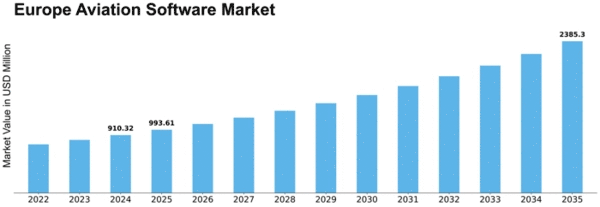
The Europe aviation software market is undergoing a major shift as the aviation industry embraces digitalization, automation, and data-driven decision-making. MRFR research points to strong overall growth, with software becoming a central enabler of efficiency, safety, and sustainability across European airlines and airports. Growing demand for operational transparency and real-time control is significantly expanding the market size and market share of aviation software in the region.
One of the primary factors driving the market is Europe’s commitment to modernization. Airlines across the region are upgrading to advanced aviation management software to streamline crew scheduling, optimize aircraft utilization, improve communication, and support operational control centers. These upgrades are essential as airlines face rising passenger traffic, tight margins, and intense competition. Software-driven optimization is helping operators save fuel, reduce delays, and simplify workflow management.
The increasing adoption of MRO software is another leading trend. European aviation is known for its high safety standards, and digital maintenance platforms allow airlines to meet regulatory compliance with greater precision. Predictive maintenance capabilities help maintenance teams identify potential failures before they occur, reducing both aircraft downtime and operational risk. As more airlines move toward data-rich maintenance ecosystems, MRO software is expected to hold a dominant share of the aviation software market by 2035.
Airports across Europe are also upgrading rapidly. From runway operations and terminal management to baggage tracking and passenger flow monitoring, aviation software is enabling airports to move toward integrated, automated, and faster operations. As Europe expands capacity and modernizes infrastructure, airport software has become essential for managing high traffic while improving traveler experience.
A key technological trend is the rising dominance of cloud-based aviation software. Cloud platforms allow operations teams to access real-time data from anywhere, streamline updates, reduce IT overhead, and integrate multiple operational systems. This cloud shift is expected to be one of the strongest growth drivers for the Europe aviation software market forecast through the coming decade.
Data analytics, AI, and machine learning are redefining the aviation software landscape. European operators are increasingly using analytics software for fuel monitoring, performance evaluation, passenger demand forecasting, and dynamic resource allocation. These tools support better decision-making and allow operators to respond quickly to operational uncertainties.
Sustainability and decarbonization efforts are also driving demand for specialized aviation software. Europe’s green aviation goals require airlines and airports to measure emissions, track fuel burn, optimize flight routes, and ensure compliance with environmental standards. Software that supports sustainability reporting is emerging as a fast-growing segment.
Market activity is particularly strong in Western Europe, where digital readiness is high and aviation ecosystems are well established. However, countries in Southern and Eastern Europe are rapidly investing in aviation modernization, creating new opportunities for software providers.
As the region continues its transition into a digitally connected aviation ecosystem, the demand for innovative aviation software will only increase. Advanced software platforms will define the next era of European aviation—an era characterized by efficiency, safety, sustainability, and seamless operational integration.
Related Report:

 Arabic
 French
 Spanish
 Portuguese
 Deutsch
 Turkish
 Dutch
Dutch
 Italiano
 Russian
 Romaian
 Portuguese (Brazil)
 Tiếng Việt